Friday, May 18, 2007

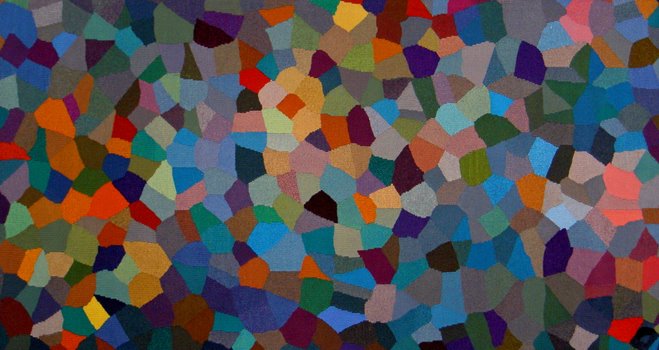
Completed weaving the tapestry Gravity


I've just finished weaving this tapestry and it is always a thrill when one finally arrives at the end of weaving one, especially if it's large, since it is such a slow process. I'm working feverishly to try to finish it for an upcoming exhibit at the Burlington Art Centre coming up in mid July and will run until the middle of September. The title of the show will be Contemporary Canadian Tapestry and will include other tapestry weavers: Marcel Marois, Jane Kidd, Barbara Heller, and Sondra MacLeod.
I wanted to show you what the back of tapestry looks like after you finish weaving it. All the ends must be sewn in so that in the end the back of the tapestry looks exactly like the front. I'll be sure to post the picture of it once it is completed.
The other exciting news is that I got into the Toronto Outdoor Art Exhibit, and I will also be doing a show in Gravenhurst and Bracebridge. For more details of all of the above go to my website at www.tapestryline.com and the info is posted on the home page.

Sunday, May 13, 2007

On the Midway


This tapestry was inspired by the tempo of life, which I compare with being on the fair grounds of a carnival. The colours I chose are reminiscent of the kinds of colours one might find at the fair grounds, like cotton candy. The movement within the piecereminds me of a game I used to play as a child; I would spin around in circles, like a revolving top, stop suddenly, and then, everything that was stationary would seem to be rotating around me like a merry go round while I stood still. When things are moving around one so quickly, it is almost impossible to distinguish or isolate objects, faces, and figures.

Saturday, May 5, 2007

About Inspiration - from Anni Albers


A Place in the Sun
2' x 4'

Collection of Miriam Grasby, Montreal

"Art work.....teaches the process of all creating, the shaping out of the shapeless. We learn from it that no picture exists before it is done, no form before it is shaped. The conception of a work gives only its temper, not its consistency. Things take shape in material and in the process of working it, and no imagination is great enough to know before the works are done what they will be like.

We come to know in art that we do not clearly know where we will arrive in our work, although we set the compass, our vision; that we are lead in going along, by material and work process. We have plans and blueprints, but the finished work is still a surprise. We learn to listen to our voices; the the yes or no of our material, our tools, our time. We come to know that only when we feel guided by them our work takes on form and meaning, that we are misled when we follow our will. All great deeds have been achieved under a sense of guidance.

We learn courage from art work. We have to go where no one was before us. We are alone and we are responsible for our actions. Our solitariness takes on religious character; this is a matter of my conscience and me.

We learn to dare to make a choice, to be independent. There is no authority to be questioned. In art work there is no established conception of work. Any decision is our own, any judgement....In making our choice(s) we develop a standpoint. How much of today's confusion is brought about through not knowing where we stand, through the inability to relate experiences directly to us. In art work any experience is immediate. We have to apply what we absorb to our work of the moment. We cannot postpone the use of what we learn. Much of our education today prepares us for a later day.

We learn to trust our intuition....we have to rely on inner awareness.....We learn patience and endurance in following through a piece of work. We learn to respect material in working it. Formed things and thoughts live a life of their own; they radiate a meaning. They need a clear form to give a clear meaning. Making something become real and take its place in actuality adds to our feeling of usefulness and security. Learning to form makes us understand all forming.....

The difficult problems are the fundamental problems; simplicity stands at the end, not at the beginning of a work. If education can lead us to elementary seeing, away from too much and too complex information, to the quietness of vision and discipline of forming, it again may prepare us for the task ahead, working for today and tomorrow.


Taken from Anni Albers: On Designing, p31-33 Weslaeyan University Press, Middleton Connecticut

Monday, April 30, 2007

Tapestry Book by Barty Phillips

In the book Tapestry by Barty Phillips and published by Phaidon Press, Line's tapestry was featured in the Contemporary Masters section on page 188. The tapestry "Effervescent Ascent" was commissioned by John and Ann Galbraith. The dimesions of the tapestry are 5' x 3'.

Friday, April 27, 2007

Woven poncho


Apart from tapestries, I also weave handwoven fashion accessories that I sell at shows, exhibits, and stores. These include scarves, shawls, ponchos and capes. I teach all this with the Toronto District School Board's Continuing Education program which you can access at www.tdsb.on.ca . Classes run from Fall to the end of Spring, from beginners to Intermediate levels.

Friday, April 20, 2007

The life of an artisan is a challenging one. A large part of my time and my life has been dedicated to pursuing a rather medieval kind of life. Weaving is a very slow process and is quite a contrast to the fast pace of modern day life. Perhaps this is what I like about weaving. That it is slow. I recently discovered a great website that discusses many aspects of the what is now becoming a 'slow movement' at www.slowmovement.com. I think it is sort of a backlash to how fast we have to live our daily lives. It doens't allow us to savour many of the better moments.

Since deciding to commit myself to being a full time fibre artist and artisan, it has also been challenging to earn a living solely by this means. So, I try to do a number of things, all related and interconnected. I teach weaving, sell weaving supplies and equipment, I do craft/art shows, and participate in exhibitions. It can be difficult living with the financial uncertainty of being an artist and craftsperson but I just can't imagine living my life doing anything but what I am doing. Being an artist/artisan is a way of life. It is also about a certain quality of life that is not necessarily connected to how much money we make.

Saturday, March 3, 2007

Bryozoa


handwoven tapestry
3' x 3'


Bryozoa are collectives of tiny acquatic organisms called zooids, living in large colonies. Often these colonies form flat encrustations as well as erect plant like structures on a variety of objects including rocks, ship bottoms, wharf pillings, sea weed and even the shells of other acquatic animals. They date as far back as 500 million years ago. This tapestry was inspired by how they live, which provides us with some guidelines in terms of ensuring our longevity and well being as a community and thus, as individuals. The long duration of the species can be attributed in part to their collective consciousness. Thus the theme of this tapestry is about our interconnectedness as individuals, and the vital connection this bears upon our structures of community. As citizens, we are woven together like a fabric, through the spirit of collaboration, concern and cooperation, and yet still maintain a sense of our individuality, equally as vital to our existence and survival.